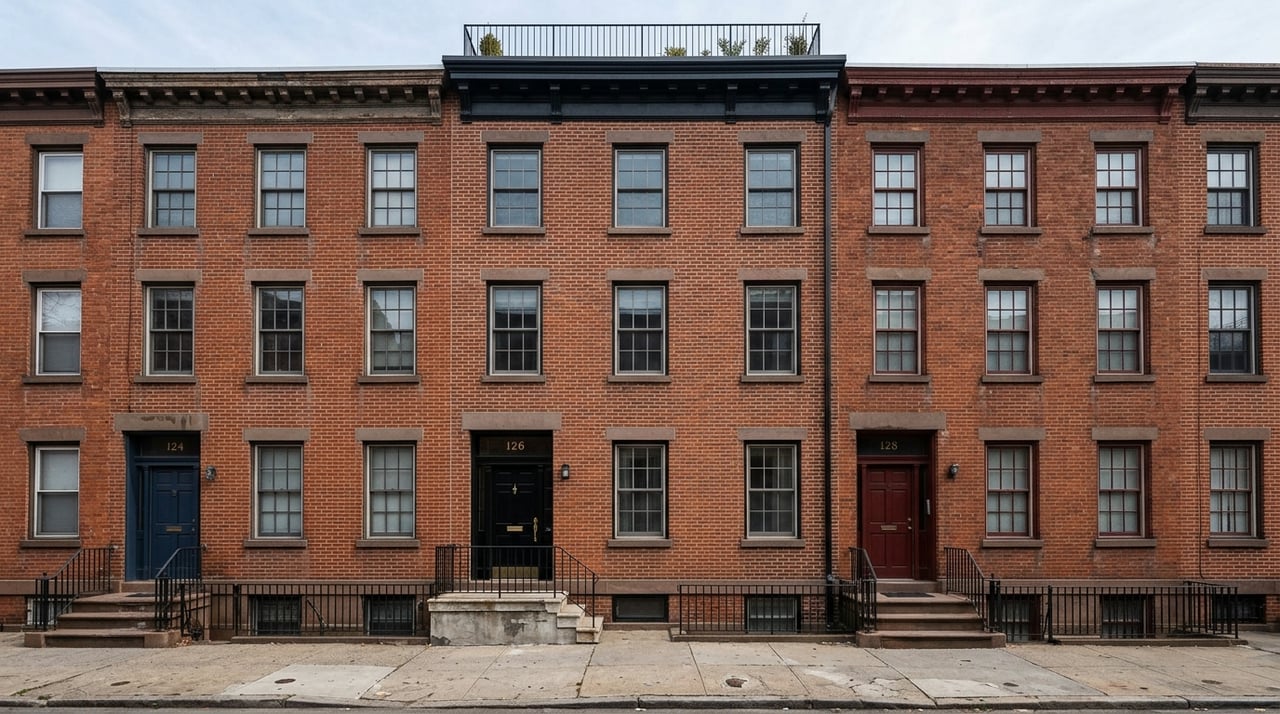
Walk down almost any block between South Street and Washington Avenue and you'll spot it: a two-story rowhome that used to top out level with its neighbors, now capped by a boxy third floor clad in black metal panel, with a roof deck perched on top. It's become the neighborhood's most recognizable renovation move, common enough that a Philadelphia home inspection company that catalogs renovated properties across the city lists a "Graduate Hospital Modernized Corner Rowhome with Pop-Up" as its own standing category, alongside Brewerytown's arched brick and Fairmount's stone doorways.
Everyone likes the way these look. Fewer people ask what's holding the new floor up, or whether the seam where old brick meets new panel was actually sealed against weather. That's the question worth asking before you write an offer, because in a market moving as fast as Graduate Hospital's is right now, it's exactly the question most buyers skip.
The pace is the problem
As of August 2026, the median home price in Graduate Hospital sits at $669,000, with the average sale price running higher at $715,249. The broader pricing trend backs that up: recent tracking puts the neighborhood's average sale price up more than 20 percent from a year earlier, and homes are going pending in around 38 days on average. The truly desirable listings, the ones with fresh finishes and a roof deck view, are moving in closer to 13 days.
That speed rewards decisiveness. It does not reward due diligence. When a corner rowhome with a slick pop-up hits the market and three other buyers are already scheduling showings, the instinct is to waive contingencies and move fast rather than spend an extra week pulling permit records. That instinct is exactly backwards for this particular type of renovation, because a pop-up is one of the few upgrades where the thing you're paying for (a taller, more valuable house) and the thing that could go wrong (a structural tie-in that was never engineered for the load) live in the same physical space.
Why the pop-up became a Graduate Hospital signature in the first place
Most of the neighborhood's rowhome stock was built as two-story housing on narrow lots, which means there was rarely room to expand outward. Adding a third floor within the existing footprint became the practical way to add square footage without touching the party walls on either side or requiring a rear yard addition. It's a smart renovation strategy on paper. In practice, it asks an old structure to carry new weight it wasn't originally framed for, which is why the corner rowhome with the black-clad addition draws more scrutiny from inspectors than a rowhome that stayed at its original height.
The construction activity backing this up is current, not historical. In July 2026, Philadelphia YIMBY reported that permits had been issued for a new three-story single-family rowhouse at 2127 Kimball Street, developed by HDG Developers with Gnome Architects designing and Lapstone LLC as contractor, on a lot that had sat vacant. The same month, permits went through for a four-story two-family building at 916 South 15th Street at the corner of Montrose Street, with Boyer Lofts LLC as owner, Ambit Architecture handling design, and City Suburban Home Builders LLC listed as contractor at a stated construction cost of $500,000. These aren't pop-ups in the strict sense, since they're new builds rather than additions to an existing structure, but they show the same underlying pattern: height and density are still being added to Graduate Hospital's rowhome blocks at a steady clip, and pop-up-style additions to existing homes are part of that same construction economy.
What separates a good pop-up from a rushed one
The finish work on a pop-up, the black panel cladding, the glass railing on the roof deck, tells you almost nothing about how well the addition was executed. The signals that matter are less visible.
| What to check | What it tells you |
|---|---|
| Permit history on file with the city | Confirms the work was reviewed and inspected, not done off the books |
| Party wall condition in the basement and attic near the addition | Step cracks or fresh patching can indicate the new floor's load wasn't distributed evenly |
| The seam where old brick meets new cladding | A poorly sealed transition is a common source of water intrusion behind the wall |
| Roof deck structural support | Decks are frequently added at the same time as pop-ups, and the framing underneath needs to be sized for it, not just for a flat roof |
| HVAC capacity relative to added square footage | A system sized for a two-story house often can't condition a third floor added later |
None of these show up in listing photos. All of them show up in a permit record or a careful inspection.
Checking the permit record before you write an offer
Philadelphia keeps permit, inspection, and violation history public through the city's Atlas portal, and it's free to search by address. Before you get emotionally attached to a listing with a pop-up, pull the property up and look for a completed building permit that matches the scope of work you're seeing, not just an electrical or plumbing permit that suggests a partial job. If the listing agent can't produce a certificate of occupancy or final inspection sign-off for the addition, that's worth raising during your inspection contingency rather than after closing.
This matters more in a fast market, not less. A licensed inspector's report can be an effective bargaining chip when problems are found, but only if you keep the contingency in place long enough to use it. Home inspectors who work regularly in the city point to the permit check as one of the most useful things a buyer can do on any renovated property, precisely because fresh paint and new fixtures are easy to fake and permit records are not. If step cracks or fresh patching show up near a party wall on a pop-up property, a follow-up from a structural engineer is a reasonable next ask, not an overreaction.
What this means if you're touring Graduate Hospital right now
A pop-up addition is not a red flag on its own. Plenty of them are permitted, properly engineered, and well worth the premium they command. The mistake is treating the finish quality as a proxy for structural quality, especially when the pace of the market is nudging you toward a decision before you've had time to check.
If you're comparing two similarly priced Graduate Hospital rowhomes, one with an addition and one without, the permit record on the addition is worth more to your decision than another round of photos. Ask for it early. Build the time to review it into your offer timeline instead of treating the inspection period as a formality to get through quickly.
A few questions that come up often
Does every corner rowhome with a black-clad third floor in Graduate Hospital have a pop-up addition? Not necessarily. Some were built as three-story structures from the start, particularly in the newer construction filling in formerly vacant lots. A quick permit search will usually tell you whether the home's current height matches its original construction or was added later.
If the pop-up was permitted, does that mean it's structurally sound? A completed permit and a final inspection sign-off show that the work went through city review and received final approval, which is a meaningful baseline. It doesn't replace an independent inspection, since inspectors sometimes catch issues that don't rise to a code violation but still matter for long-term maintenance, like a marginal seal at a cladding transition.
How much time do I realistically have to check permit history during a fast-moving deal? Atlas searches take minutes once you have the address, so this is something you or your agent can do before you even submit an offer, not something that has to eat into your inspection contingency window.
If you're weighing a Graduate Hospital rowhome with a pop-up against one without, or you want a second set of eyes on a permit record before you commit to an offer, The Eric Fox Team spends its days in these blocks and knows which questions the listing photos won't answer. Reach out through our Graduate Hospital neighborhood page or connect with our team directly, and we'll help you read the permit history before you write the offer, not after.
This article is general information, not legal, tax or financial advice. Consult a qualified professional about your situation.